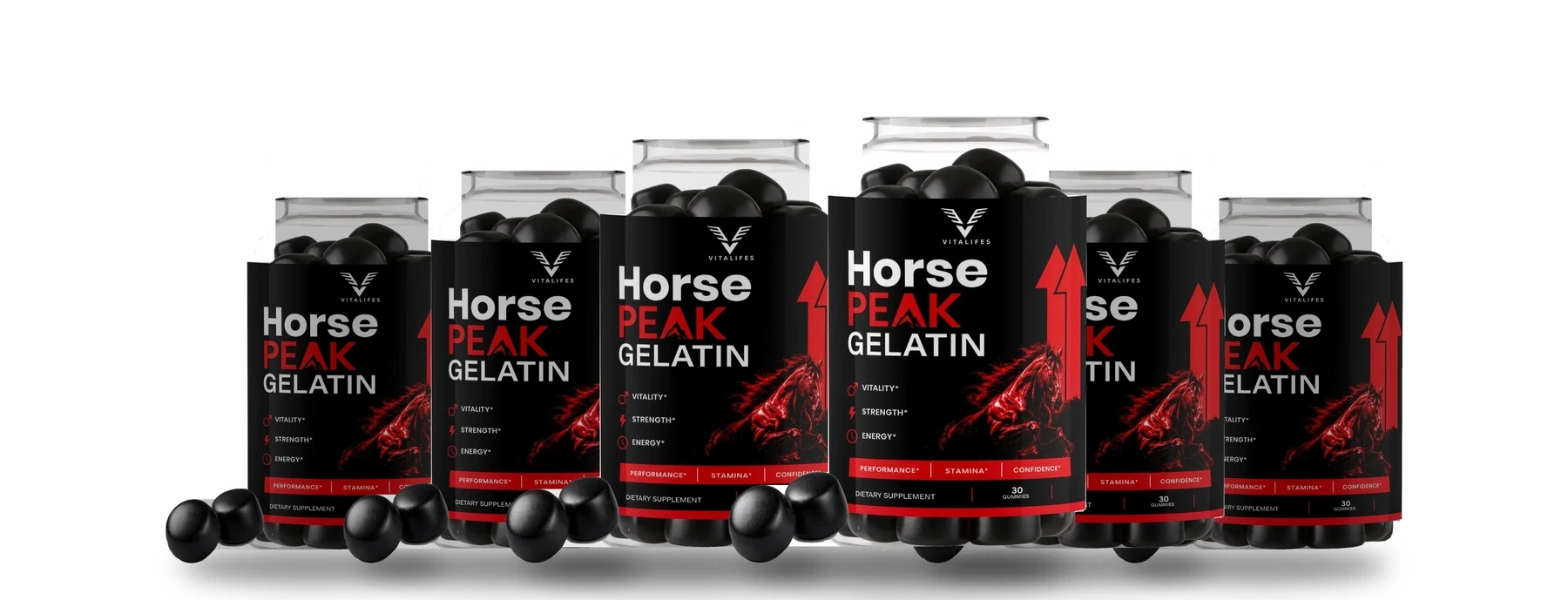
Horse Peak Gelatin Official Website › Vitality Supplement Guide
Vitality Supplement GuideA Guide To Men’s Vitality Supplements
Six ingredients dominate this shelf, and their published records are wildly unequal.
Two are nutrients with defined ceilings. Two have real trials at gram doses. One has a trial record that contradicts itself. One has no human oral dosing trial at all. Knowing which is which is most of what a buyer on this shelf needs.
Written to be useful to somebody who buys a different product at the end of it. Every dose here is the dose the trial actually used, read from the paper rather than from a marketing page.
What this category is, and what it is not
A men’s vitality supplement is a dietary supplement sold against a cluster of broad words: energy, stamina, drive, performance. Those words are permitted because they name a normal function rather than a condition. The moment a label names a condition it has stopped being a supplement claim.
That distinction does most of the work in this category. A product may say it supports vitality; it may not say it treats erectile dysfunction. Persistent difficulty with erections is common and it travels with cardiovascular disease often enough to be an early signal, which is why it belongs with a clinician and not on a shelf. MedlinePlus is a plain starting point.
The second thing worth knowing before reading any label is that this category has the worst adulteration record in supplements. Of 776 products the FDA warned about between 2007 and 2016, 353 were sold for sexual enhancement, and the usual finding was an undeclared drug analogue rather than a missing ingredient. Detecting those analogues is a whole analytical literature. That is a base rate about a shelf, not an allegation about any product on it.
The six ingredients, by the dose the trials used
| Ingredient | The strongest published work | The dose it used |
|---|---|---|
| Vitamin D3 | A trial in 307 infertile men and a 2026 meta-analysis | 1,400 IU a day after a loading dose. No overall change in sex steroids |
| Boron | Eight healthy men, one week | 10 mg a day. Free testosterone rose; no control group |
| Fenugreek | Two twelve-week trials and a 2024 dose-ranging study | 600 mg a day of a standardised seed extract; 600, 1,200 and 1,800 mg in the third |
| Maca | A twelve-week trial on sexual desire | 1,500 and 3,000 mg a day. Desire improved; testosterone did not move |
| Tribulus | A trial in 180 men, against one at a lower dose | 1,500 mg a day of a 35-45:1 extract improved a score; 800 mg matched placebo |
| Horny goat weed | A test-tube study and work in rats | No human oral dosing trial exists to quote |
Every dose in the right-hand column was read from that paper's own abstract rather than from a summary of it.
The gap between the second and third columns is the whole of what a label on this shelf is arguing with. A product that prints 100 mcg of fenugreek is printing four ten-thousandths of a gram against a trial that used six hundred milligrams.
Nothing about that makes the ingredient fake. It makes the amount too small to reproduce the result the ingredient is famous for, which is a different and more useful statement.
Vitamin D and boron: the two with ceilings
These two behave differently from the botanicals because they are nutrients. They have defined intakes, defined upper limits, and a body of evidence that is about correcting a shortfall rather than about producing an effect.
The adult tolerable upper intake level for vitamin D is 4,000 IU, or 100 micrograms, a day. That is the figure to add every label in your cupboard against, because vitamin D hides in multivitamins, calcium combinations and cod liver oil as well as in standalone capsules. Over-supplementation has a documented case record and the 2024 Endocrine Society guideline is the current professional statement.
Boron's adult upper intake level is 20 mg a day. The interest in it for this category rests almost entirely on one week-long study in eight men, with a 1987 metabolic-unit study behind it at 3 mg a day. A general review and a 2026 review of boron as a supplement put both in context.
The practical consequence for a buyer is that these are the two rows on any label in this category worth checking arithmetic on, and the two worth adding across products.
What a plant-to-extract ratio actually describes
Four of the six ingredients above routinely appear on labels as a ratio: 4:1, 10:1, 20:1. It reads like a strength and it is not one.
The United States Pharmacopeia group's paper on the subject explains it plainly. A plant-to-extract ratio describes the relationship between the starting material and the finished extract in the process that made it. It cannot be verified by any method of analysis, and it is nonetheless, in their words, often used as a measure of extract strength for dosage calculations.
Two products both printing 10:1 may therefore have used different starting material, different solvents and different yields, and nothing on either label distinguishes them. The comparison people make between such labels is not a comparison of anything.
The figure that does mean something is a standardisation: a stated percentage of a named marker compound. The largest tribulus trial used an extract standardised to not less than 112.5 mg of furostanol saponins, which is a specification somebody could test. A ratio is not.
Variability is not hypothetical here. Epimedium material has been shown to vary substantially between sources, which is the argument for reading an amount and a standardisation rather than a name and a ratio.
Testosterone, and what the reviews of this category found
Most of this shelf is sold, directly or by implication, on testosterone. The honest summary of the published work is unglamorous.
A systematic review asking whether testosterone boosters raise serum testosterone is the single most useful paper a buyer on this shelf can read. An evidence-based analysis of the ingredients in popular male testosterone and erectile dysfunction supplements covers what is actually in them.
On the broader question of herbal products for erectile dysfunction, a 2018 meta-analysis and a 2026 one reach modest conclusions at proper doses. Modest at proper doses is the phrase to hold on to, because almost nothing on a retail shelf contains a proper dose.
Two individual results are worth knowing because they are so often misquoted. The maca trial found sexual desire improved while serum testosterone did not change at all, which is a more interesting finding than the one usually reported. And the systematic review of the tribulus aphrodisiac claim found little to support it.
What the evidence in this area does support
Two things, and neither is sold in a bottle.
A meta-analysis of randomised trials of aerobic exercise found a measurable effect on erectile function. A 2026 meta-analysis of lifestyle interventions found the same direction of travel across a broader set of changes.
No supplement in this category has a record like that. Anything bought here sits on top of sleep, weight, alcohol and activity rather than in place of them, and a buyer who fixes one of those four will out-perform any label on this shelf.
That is not an argument against buying a supplement. It is an argument for buying one with the right expectation, and for spending the first sixty days changing one thing rather than four. The NIH's guidance on using supplements wisely is a good place to start.
The format question: capsules, drops and gummies
| Format | What it does better | What it costs |
|---|---|---|
| Capsule | Holds larger amounts. No sugar. Cheapest to manufacture. | Needs water and gets skipped, which is the failure mode nobody measures. |
| Liquid drops | Flexible dosing. Fast to take. | Measuring is imprecise and a dropper is easy to misjudge. |
| Chewable gummy | Taken without water. The habit survives better. | Carries sugar, degrades in heat, and gummies have their own record on label accuracy. |
A comparison of formats rather than of products. The right answer depends entirely on which failure mode applies to you.
The gummy format's honest case is adherence. A supplement taken on twenty-eight days out of thirty beats a better one taken on nine, and for some people the difference between those two numbers is whether it needs a glass of water.
Its honest cost is three-fold: sugar, heat sensitivity and a manufacturing process with more room for the contents to drift from the label. The assay work on melatonin gummies is about a different ingredient and a different set of makers, and it is still the reason to treat the format with the same scepticism as any other rather than less.
Ten things to read on any label in this category
- The serving size, before anything else. Every other number on the panel means something different without it.
- Whether every active carries its own amount, or whether a blend total hides them.
- The vitamin D figure, converted to international units, and added to every other product you take.
- Any mineral with an upper intake level, which on this shelf usually means boron or zinc.
- Whether a botanical carries a standardisation as well as a ratio.
- The Other Ingredients line, which on a gummy names the gelling agent.
- An allergen statement, particularly if badges on the pack imply one.
- The caution, in the manufacturer's own words rather than as a website summarises it.
- The expiry, and whether it matches the stamp on the bottle you were sent.
- The refund window, and which date it is counted from.
Nine of those ten can be done holding the bottle. The tenth is on the seller's page, and it is the one most people read last.
Sources for this guide
Thirty-three records, each linked inside the sentence on this page that uses it.
- Holt R, Yahyavi SK, Kooij I, et al. Effects of vitamin D on sex steroids, luteinizing hormone, and testosterone to luteinizing hormone ratio in 307 infertile men. Andrology. 2024;12(3):553-560. PMID 37555466. https://pubmed.ncbi.nlm.nih.gov/37555466/
- Paez-Allendes L, Valenzuela-Fuenzalida JJ, Moya MP, et al. Vitamin D Supplementation, Total Testosterone, and Androgen Bioavailability Markers in Adult Men: A Systematic Review and Meta-Analysis of Randomized Controlled Trials. Nutrients. 2026;18(13). PMID 42451097. https://pubmed.ncbi.nlm.nih.gov/42451097/
- Institute of Medicine (US) Committee to Review Dietary Reference Intakes for Vitamin D and Calcium; Ross AC, Taylor CL, Yaktine AL, Del Valle HB, editors. Tolerable Upper Intake Levels: Calcium and Vitamin D. In: Dietary Reference Intakes for Calcium and Vitamin D. Washington (DC): National Academies Press (US); 2011. https://www.ncbi.nlm.nih.gov/books/NBK56058/
- Gordon L, Zipursky R, Cheung CC, et al. Vitamin D Intoxication in an Adolescent due to Over-Supplementation: A Case Report and Review of Literature. AACE Endocrinol Diabetes. 2026;13(1):93-97. PMID 41641290. https://pubmed.ncbi.nlm.nih.gov/41641290/
- Pilz S, Pludowski P, Kraus DA, et al. The 2024 Endocrine Society Guideline on Vitamin D: Comprehensive Summary and Critical Appraisal. Nutrients. 2026;18(9). PMID 42124073. https://pubmed.ncbi.nlm.nih.gov/42124073/
- Naghii MR, Mofid M, Asgari AR, et al. Comparative effects of daily and weekly boron supplementation on plasma steroid hormones and proinflammatory cytokines. J Trace Elem Med Biol. 2011;25(1):54-8. PMID 21129941. https://pubmed.ncbi.nlm.nih.gov/21129941/
- Nielsen FH, Hunt CD, Mullen LM, Hunt JR. Effect of dietary boron on mineral, estrogen, and testosterone metabolism in postmenopausal women. FASEB J. 1987;1(5):394-7. PMID 3678698. https://pubmed.ncbi.nlm.nih.gov/3678698/
- Pizzorno L. Nothing Boring About Boron. Integr Med (Encinitas). 2015;14(4):35-48. PMID 26770156. https://pubmed.ncbi.nlm.nih.gov/26770156/
- Kuru-Yasar R, Yarat A. The Role of Boron in the Diet and as a Dietary Supplement. Handb Exp Pharmacol. 2026. PMID 42185672. https://pubmed.ncbi.nlm.nih.gov/42185672/
- Institute of Medicine (US) Panel on Micronutrients. Arsenic, Boron, Nickel, Silicon, and Vanadium. In: Dietary Reference Intakes for Vitamin A, Vitamin K, Arsenic, Boron, Chromium, Copper, Iodine, Iron, Manganese, Molybdenum, Nickel, Silicon, Vanadium, and Zinc. Washington (DC): National Academies Press (US); 2001. https://www.ncbi.nlm.nih.gov/books/NBK222322/
- Rao A, Steels E, Inder WJ, et al. Testofen, a specialised Trigonella foenum-graecum seed extract reduces age-related symptoms of androgen decrease, increases testosterone levels and improves sexual function in healthy aging males in a double-blind randomised clinical study. Aging Male. 2016;19(2):134-42. PMID 26791805. https://pubmed.ncbi.nlm.nih.gov/26791805/
- Lee-Odegard S, Gundersen TE, Drevon CA. Effect of a plant extract of fenugreek (Trigonella foenum-graecum) on testosterone in blood plasma and saliva in a double blind randomized controlled intervention study. PLoS One. 2024;19(9):e0310170. PMID 39288153. https://pubmed.ncbi.nlm.nih.gov/39288153/
- Gonzales GF, Cordova A, Vega K, et al. Effect of Lepidium meyenii (MACA) on sexual desire and its absent relationship with serum testosterone levels in adult healthy men. Andrologia. 2002;34(6):367-72. PMID 12472620. https://pubmed.ncbi.nlm.nih.gov/12472620/
- Kamenov Z, Fileva S, Kalinov K, Jannini EA. Evaluation of the efficacy and safety of Tribulus terrestris in male sexual dysfunction-A prospective, randomized, double-blind, placebo-controlled clinical trial. Maturitas. 2017;99:20-26. PMID 28364864. https://pubmed.ncbi.nlm.nih.gov/28364864/
- Santos CA Jr, Reis LO, Destro-Saade R, et al. Tribulus terrestris versus placebo in the treatment of erectile dysfunction: A prospective, randomized, double blind study. Actas Urol Esp. 2014;38(4):244-8. PMID 24630840. https://pubmed.ncbi.nlm.nih.gov/24630840/
- Qureshi A, Naughton DP, Petroczi A. A systematic review on the herbal extract Tribulus terrestris and the roots of its putative aphrodisiac and performance enhancing effect. J Diet Suppl. 2014;11(1):64-79. PMID 24559105. https://pubmed.ncbi.nlm.nih.gov/24559105/
- Dell'Agli M, Galli GV, Dal Cero E, et al. Potent inhibition of human phosphodiesterase-5 by icariin derivatives. J Nat Prod. 2008;71(9):1513-7. PMID 18778098. https://pubmed.ncbi.nlm.nih.gov/18778098/
- Shindel AW, Xin ZC, Lin G, et al. Erectogenic and neurotrophic effects of icariin, a purified extract of horny goat weed (Epimedium spp.) in vitro and in vivo. J Sex Med. 2010;7(4 Pt 1):1518-28. PMID 20141584. https://pubmed.ncbi.nlm.nih.gov/20141584/
- Yong EL, Wong SP, Shen P, et al. Standardization and evaluation of botanical mixtures: lessons from a traditional Chinese herb, Epimedium, with oestrogenic properties. Novartis Found Symp. 2007;282:173-88. PMID 17913231. https://pubmed.ncbi.nlm.nih.gov/17913231/
- Monagas M, Brendler T, Brinckmann J, et al. Understanding plant to extract ratios in botanical extracts. Front Pharmacol. 2022;13:981978. PMID 36249773. https://pubmed.ncbi.nlm.nih.gov/36249773/
- Morgado A, Tsampoukas G, Sokolakis I, et al. Do "testosterone boosters" really increase serum total testosterone? A systematic review. Int J Impot Res. 2024;36(4):348-364. PMID 37697053. https://pubmed.ncbi.nlm.nih.gov/37697053/
- Kuchakulla M, Narasimman M, Soni Y, et al. A systematic review and evidence-based analysis of ingredients in popular male testosterone and erectile dysfunction supplements. Int J Impot Res. 2021;33(3):311-317. PMID 32358510. https://pubmed.ncbi.nlm.nih.gov/32358510/
- Borrelli F, Colalto C, Delfino DV, et al. Herbal Dietary Supplements for Erectile Dysfunction: A Systematic Review and Meta-Analysis. Drugs. 2018;78(6):643-673. PMID 29633089. https://pubmed.ncbi.nlm.nih.gov/29633089/
- Ho CY, Hsu CH, Chien TJ. Herbal dietary supplements for erectile dysfunction: A systematic review and meta-analysis of randomized-controlled trials. J Tradit Complement Med. 2026;16(1):109-120. PMID 41696741. https://pubmed.ncbi.nlm.nih.gov/41696741/
- Tucker J, Fischer T, Upjohn L, Mazzera D, Kumar M. Unapproved Pharmaceutical Ingredients Included in Dietary Supplements Associated With US Food and Drug Administration Warnings. JAMA Netw Open. 2018;1(6):e183337. PMID 30646238. https://pubmed.ncbi.nlm.nih.gov/30646238/
- Patel DN, Li L, Kee CL, et al. Screening of synthetic PDE-5 inhibitors and their analogues as adulterants: analytical techniques and challenges. J Pharm Biomed Anal. 2014;87:176-90. PMID 23721687. https://pubmed.ncbi.nlm.nih.gov/23721687/
- Cohen PA, Avula B, Wang YH, Katragunta K, Khan I. Quantity of Melatonin and CBD in Melatonin Gummies Sold in the US. JAMA. 2023;329(16):1401-1402. PMID 37097362. https://pubmed.ncbi.nlm.nih.gov/37097362/
- Khera M, Bhattacharyya S, Miller LE. Effect of aerobic exercise on erectile function: systematic review and meta-analysis of randomized controlled trials. J Sex Med. 2023;20(12):1369-1375. PMID 37814532. https://pubmed.ncbi.nlm.nih.gov/37814532/
- Li T, He X, Huang W, et al. Efficacy of lifestyle interventions in treating erectile dysfunction: a systematic review and meta-analysis of randomized controlled trials. J Sex Med. 2026;23(6). PMID 42143598. https://pubmed.ncbi.nlm.nih.gov/42143598/
- Kessler A, Sollie S, Challacombe B, Briggs K, Van Hemelrijck M. The global prevalence of erectile dysfunction: a review. BJU Int. 2019;124(4):587-599. PMID 31267639. https://pubmed.ncbi.nlm.nih.gov/31267639/
- An J, Xiang B, Peng J, et al. Understanding the erectile dysfunction-cardiovascular disease connection: clinical and pathophysiological insights. Sex Med Rev. 2025;13(3):406-422. PMID 40153594. https://pubmed.ncbi.nlm.nih.gov/40153594/
- Erectile Dysfunction. MedlinePlus, U.S. National Library of Medicine. https://medlineplus.gov/erectiledysfunction.html
- Using Dietary Supplements Wisely. National Center for Complementary and Integrative Health, National Institutes of Health. https://www.nccih.nih.gov/health/using-dietary-supplements-wisely
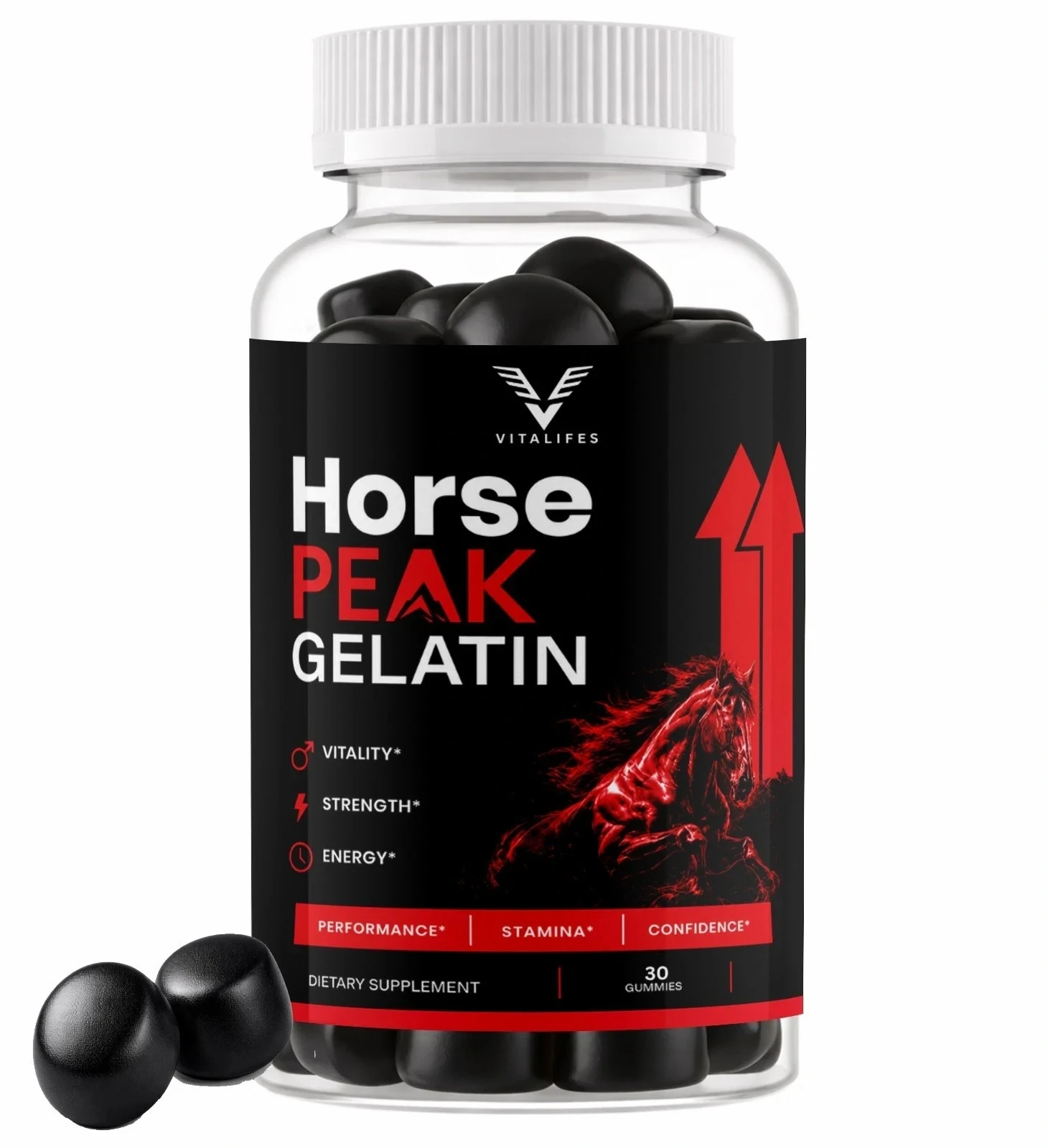
Read the Horse Peak Gelatin panel against this guide
Every amount on this label is printed, which means the whole of the guide above can be applied to it without guessing at anything.
Two bottles $158 · six bottles $294 · 60-day money-back guarantee
Order Horse Peak Gelatin On The Official WebsiteOne gummy a day · 30 on the bottle front · lot HOR-26/GO-6588