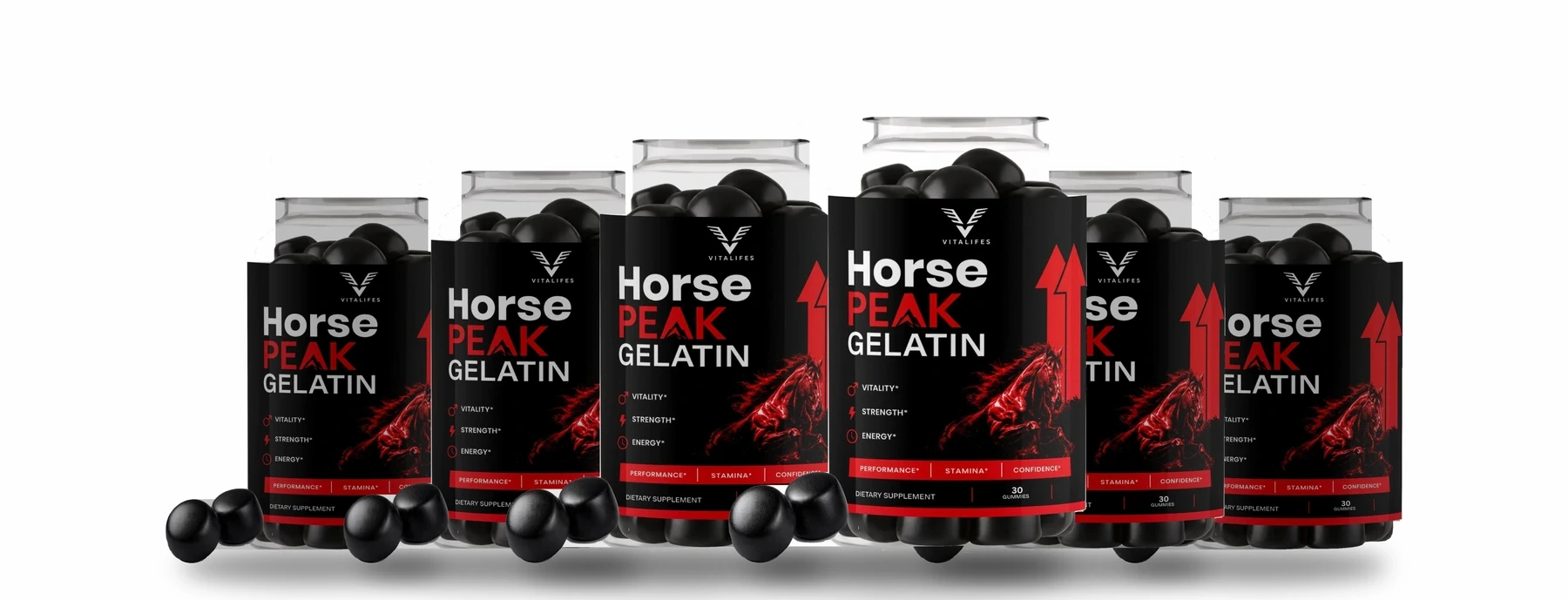
Horse Peak Gelatin Official Website › Blog › Twenty Calories And Three Grams
HorsePeak Gelatin Calories and Sugar per Gummy
One HorsePeak Gelatin gummy has 20 calories and 3 grams of sugar. The panel prints a four line nutrition block, which most gummies leave off. This post explains each line, adds it up over a bottle and says who should count it.
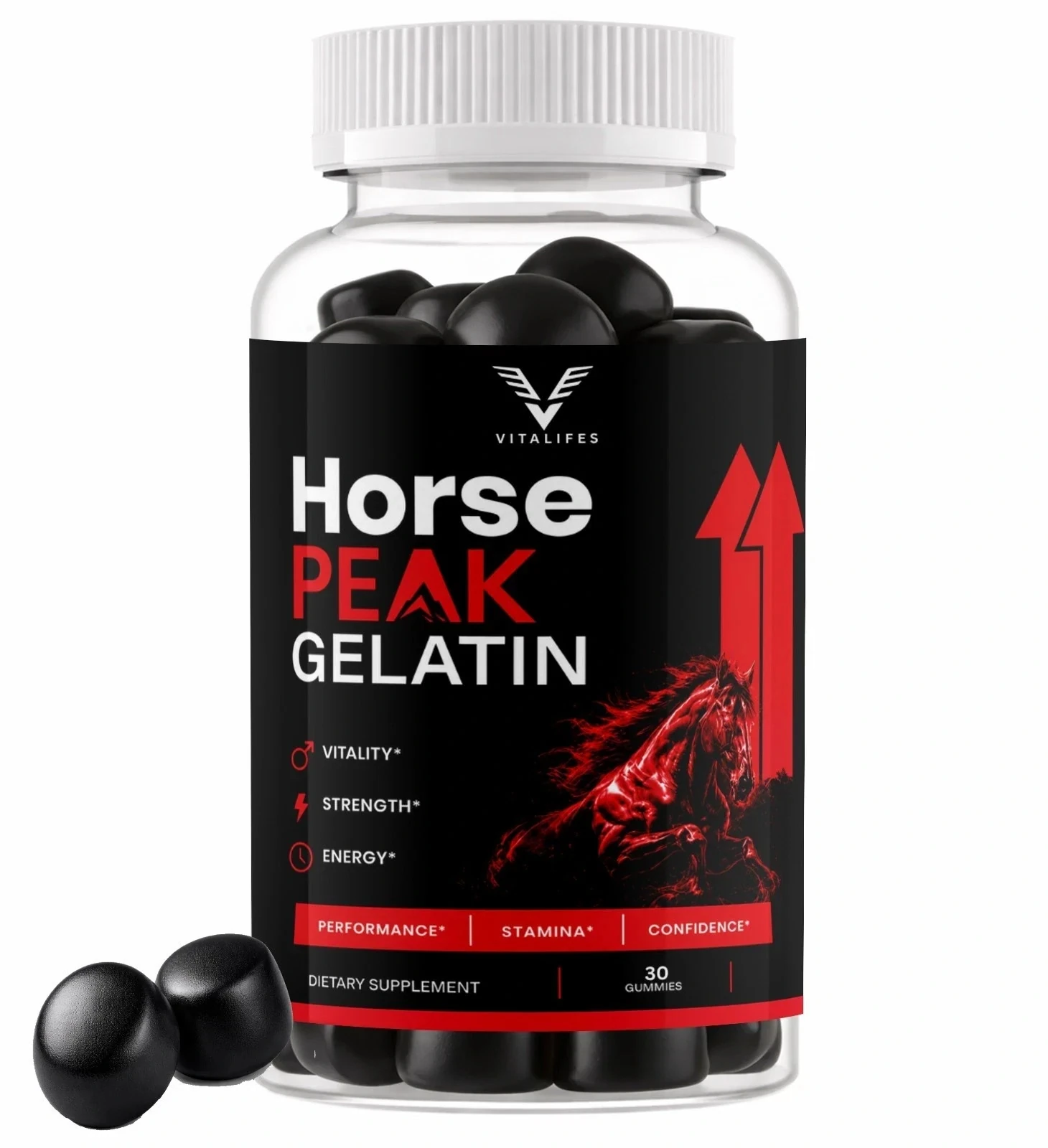
- The panel prints 20 calories, 4 g of carbohydrate, 3 g of total sugars and 0 added sugars a gummy.
- Zero added sugars beside three grams of total sugars means the sweetness comes with an ingredient rather than poured in separately.
- Over a thirty-gummy bottle that is 600 calories and 90 g of sugar.
- It is small for most people and it is not nothing for some, which is the entire honest position.
- No capsule has this row, and that is the trade the format asks you to make.
The four lines, and what each one means
Most supplement panels start at the first vitamin. A gummy panel starts higher, with a nutrition block, because a gummy is partly a food.
Calories: 20
Almost all of it is the carbohydrate. Twenty calories is small enough that it disappears into any ordinary day and large enough to be worth printing, which is presumably why the convention exists.
Total carbohydrate: 4 g
This is everything digestible in the gummy that is not protein or fat: the sugars, plus whatever sets the gel. The panel gives it as 1% of a Daily Value, which checks out against the 275 g figure.
Total sugars: 3 g
Three quarters of the carbohydrate. It is the line that matters to anybody counting, and it is the one most gummy labels in this category leave off the panel entirely.
Includes added sugars: 0
The line that causes the most confusion, and the subject of the next section.
Added sugars, total sugars and the difference
Seeing zero added sugars beside three grams of total sugars looks like a contradiction and is not. The two lines measure different things.
Total sugars counts every sugar present, whatever its origin. Added sugars counts only those put in during processing as sugar. A sweetener that arrives as part of another ingredient, such as a fruit concentrate or certain syrups used as gelling media, can contribute to the first line without registering on the second.
That is a labelling distinction rather than a nutritional one. Three grams of sugar behaves the same way in a day's total whichever line it appears on, and a reader who treats zero added sugars as zero sugar has been misled by the layout rather than by a sentence.
Total sugars is the number to count. Added sugars tells you how it got there.
Order Horse Peak Gelatin with the nutrition block in view
Twenty calories, four grams of carbohydrate and three grams of total sugars a gummy, printed on the panel rather than left off it.
Two bottles $158 · six bottles $294 · 60-day money-back guarantee
Order Horse Peak Gelatin On The Official WebsiteOne gummy a day · 30 on the bottle front · lot HOR-26/GO-6588
What it adds up to over a bottle
Per-serving figures are hard to feel. A month of them is easier.
| Over one bottle at one a day | Amount | In context |
|---|---|---|
| Calories | 600 | About two and a half hours of an average adult day's intake, spread across a month |
| Total carbohydrate | 120 g | Roughly the carbohydrate in five slices of bread |
| Total sugars | 90 g | Roughly three cans of a standard soft drink, spread across thirty days |
| Added sugars | 0 | As printed on the panel |
Thirty days of a thirty-gummy bottle, at the serving the label states. Arithmetic on the printed per-serving figures and nothing else.
Ninety grams of sugar across thirty days is about three grams a day, which is where we came in. Spread that thinly and it is a rounding error in most diets.
Concentrated, it is not. If somebody takes three different gummy supplements, which is increasingly common, the same arithmetic reaches nine grams a day and 270 g over a month, and nobody reads three nutrition blocks and adds them up.
That is the practical use of this line: not to worry about one gummy, but to notice when one has become three.
What the sugar is doing there at all
It is not padding and it is not a marketing decision. A gummy is a gel, and a gel needs something to hold its structure, carry the flavour and mask what the actives taste of. In practice that is a sugar or a sugar alcohol, and the amount is set by texture rather than by nutrition.
That is why the figure lands where it does across the whole category. Two to four grams a serving is the range a chewable of this size occupies almost regardless of what is in it, and a label printing zero total sugars has usually used a sugar alcohol instead, which brings a different set of trade-offs.
It also explains the heat sensitivity. The same structure that makes a gummy chewable at room temperature makes it a single mass at thirty-five degrees, which is the most common way a bottle of these is ruined.
The line most gummy labels leave off
The reason this post exists at all is that printing the nutrition block is optional in practice and most of this category skips it. A panel that starts at the first vitamin tells a buyer nothing about what the gummy is made of.
Where the block is absent, the sugar has not gone anywhere. It is simply not on the page, and the buyer counting carbohydrate has no figure to enter. Printing four lines that nobody is forced to print is a small piece of evidence about how a label was put together.
Who should count it and who should not
- Count it if you are tracking carbohydrate closely. Four grams a day is a real entry in a log that goes to the gram.
- Count it if you take more than one gummy supplement. The figures add up and nobody adds them.
- Count it if a clinician has asked you to watch sugar. That is the conversation to have with the panel in front of you rather than from memory.
- Do not lose sleep over it otherwise. Three grams is less than a teaspoon and it arrives once a day.
One related note that belongs here rather than in a warning list. Fenugreek at gram doses has a measurable effect on blood glucose. The amount on this panel is 100 micrograms, which is several thousand times smaller, so the relevant sugar question on this label is the three grams rather than the botanical.
The trade the gummy format asks you to make
Every format in this category asks for something in exchange for what it gives.
| Chewable gummy | Capsule | Liquid drops | |
|---|---|---|---|
| Needs water | No | Usually | No |
| Carries sugar | Typically 2 to 4 g a serving | None | Usually none |
| Calories a serving | 15 to 30 | Negligible | Negligible |
| How much active it can hold | Limited by taste and texture | The most of the three | Limited by solubility |
| Heat tolerance | Poor. Fuses into a block | Good | Good |
| Dose precision | Exact, one unit | Exact, one unit | Depends on the dropper |
| Gets skipped | Least often, on adherence grounds | Most often | In between |
A comparison of formats rather than of products. The right answer depends entirely on which of these rows describes your own failure mode.
The gummy's case is adherence, and it is a stronger case than it sounds. A supplement taken on twenty-eight days out of thirty beats a better one taken on nine, and for a certain kind of person the difference between those two numbers is entirely whether it needs a glass of water.
Its costs are the sugar, the heat sensitivity and a manufacturing process with more variables in it than pressing a powder into a capsule. Assay work on melatonin gummies found wide variation between label and content on a different ingredient made by different manufacturers, which is a reason to hold the format to the same standard as any other rather than to a lower one.
Heat is the cost people meet first. A jar left in a car in summer arrives as one block, which is not unsafe and is no longer thirty doses.
Choosing a format honestly
The question is not which format is better. It is which of the rows in that table describes you.
- If you have ever thrown away a half-full capsule bottle, the gummy is solving your actual problem and three grams of sugar is a fair price.
- If you take capsules happily and track your intake to the gram, the capsule is the better instrument and the gummy is buying you nothing.
- If you need a large amount of a single nutrient, the capsule wins on physics: there is only so much active you can put in something that has to taste acceptable.
- If you are buying for somebody who dislikes swallowing pills, the argument is settled before any of the other rows matter.
On this particular product the deciding row is usually the first. The two amounts that do real work here are a vitamin D3 figure with a ceiling worth checking and a boron figure, and both of those exist in capsule form for a fraction of the price. What the gummy adds is that it gets taken.
The routine page covers anchoring the habit, and the panel page reproduces every figure in this post. The NIH guidance on using supplements wisely and the safety literature on the botanicals are both worth a read before adding anything to a routine.
References
- Cohen PA, Avula B, Wang YH, Katragunta K, Khan I. Quantity of Melatonin and CBD in Melatonin Gummies Sold in the US. JAMA. 2023;329(16):1401-1402. PMID 37097362. https://pubmed.ncbi.nlm.nih.gov/37097362/
- Institute of Medicine (US) Committee to Review Dietary Reference Intakes for Vitamin D and Calcium; Ross AC, Taylor CL, Yaktine AL, Del Valle HB, editors. Tolerable Upper Intake Levels: Calcium and Vitamin D. In: Dietary Reference Intakes for Calcium and Vitamin D. Washington (DC): National Academies Press (US); 2011. https://www.ncbi.nlm.nih.gov/books/NBK56058/
- Shabil M, Bushi G, Bodige PK, et al. Effect of Fenugreek on Hyperglycemia: A Systematic Review and Meta-Analysis. Medicina (Kaunas). 2023;59(2). PMID 36837450. https://pubmed.ncbi.nlm.nih.gov/36837450/
- Using Dietary Supplements Wisely. National Center for Complementary and Integrative Health, National Institutes of Health. https://www.nccih.nih.gov/health/using-dietary-supplements-wisely
- Gonzales-Arimborgo C, Yupanqui I, Montero E, et al. Acceptability, Safety, and Efficacy of Oral Administration of Extracts of Black or Red Maca (Lepidium meyenii) in Adult Human Subjects: A Randomized, Double-Blind, Placebo-Controlled Study. Pharmaceuticals (Basel). 2016;9(3). PMID 27548190. https://pubmed.ncbi.nlm.nih.gov/27548190/
More about Horse Peak Gelatin
Order Horse Peak Gelatin knowing what the format costs
Twenty calories and three grams of sugar a day, printed on the panel, against a routine that needs no water and gets skipped less often.
Two bottles $158 · six bottles $294 · 60-day money-back guarantee
Order Horse Peak Gelatin On The Official WebsiteOne gummy a day · 30 on the bottle front · lot HOR-26/GO-6588